Fine-Tuning Is a Lifecycle, Not a Training Run
How to operate an adapted model with evaluation gates, versioning, monitoring, and a disciplined rollback path.

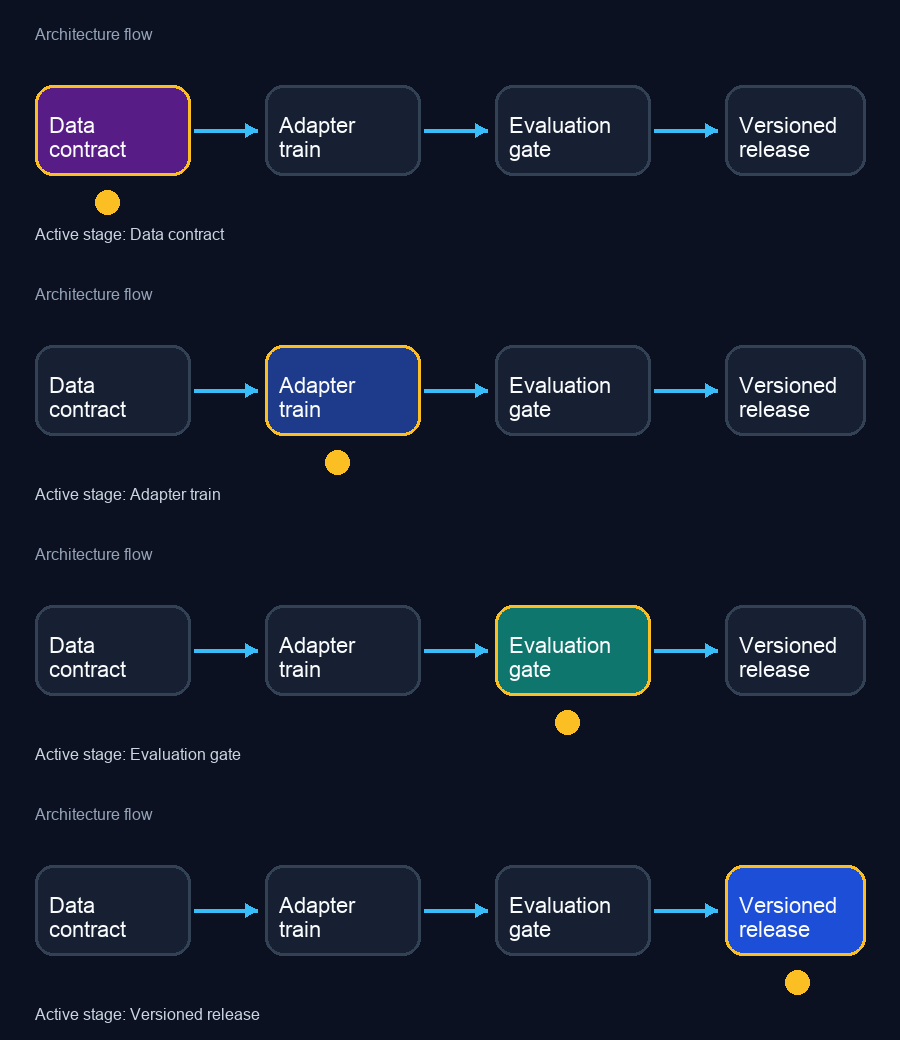
A fine-tuned model is a new production artifact, not a finished experiment. It needs a versioned base model, a versioned dataset, a declared training recipe, immutable evaluation results, and a rollback target. Without that chain, a surprising output cannot be traced back to a controllable change.
Before release, I would evaluate both capability and safety. Capability tests measure the specialized task. Safety tests measure policy compliance, privacy behavior, robustness to adversarial inputs, and behavior outside the training distribution. A held-out set must remain truly held out; otherwise it becomes an optimistic echo of the training data.
After release, monitor outcome quality, disagreement with reviewers, drift in request mix, latency, and cost. The NIST AI RMF treats risk management as continuous across the lifecycle, which is the right mental model for an adapted system that may encounter new data and incentives (Tabassi).
The final lesson is that fine-tuning should earn its complexity. When the task changes, revisit the data contract and the evaluation suite first. A smaller adapter update, an improved retrieval system, or a clearer workflow may be safer than another uncontrolled training run.
A release gate should include a comparison with the last approved version, not only an absolute score. Regressions can hide inside averages: a new adapter may improve general helpfulness while weakening a critical refusal behavior or an important minority task. Version-to-version slices make those changes visible before customers encounter them.
Rollback needs to be rehearsed. Keep the previous base, adapter, prompt configuration, and evaluation evidence accessible; define who can disable the new model; and verify that the application fails safely if an artifact cannot be loaded. A model lifecycle is mature when retirement is as deliberate as deployment.
Works Cited
- Tabassi, Elham. Artificial Intelligence Risk Management Framework (AI RMF 1.0). National Institute of Standards and Technology, 2023.
- Hu, Edward J., et al. “LoRA: Low-Rank Adaptation of Large Language Models.” arXiv, 2021.
- Hayou, Soufiane, Nikhil Ghosh, and Bin Yu. “LoRA+: Efficient Low Rank Adaptation of Large Models.” arXiv, 2024.