A Safer Pattern for Financial Agents: Propose, Verify, Approve, Execute
Why financial agents should be built as controlled workflows with segregated duties and explicit approval gates.

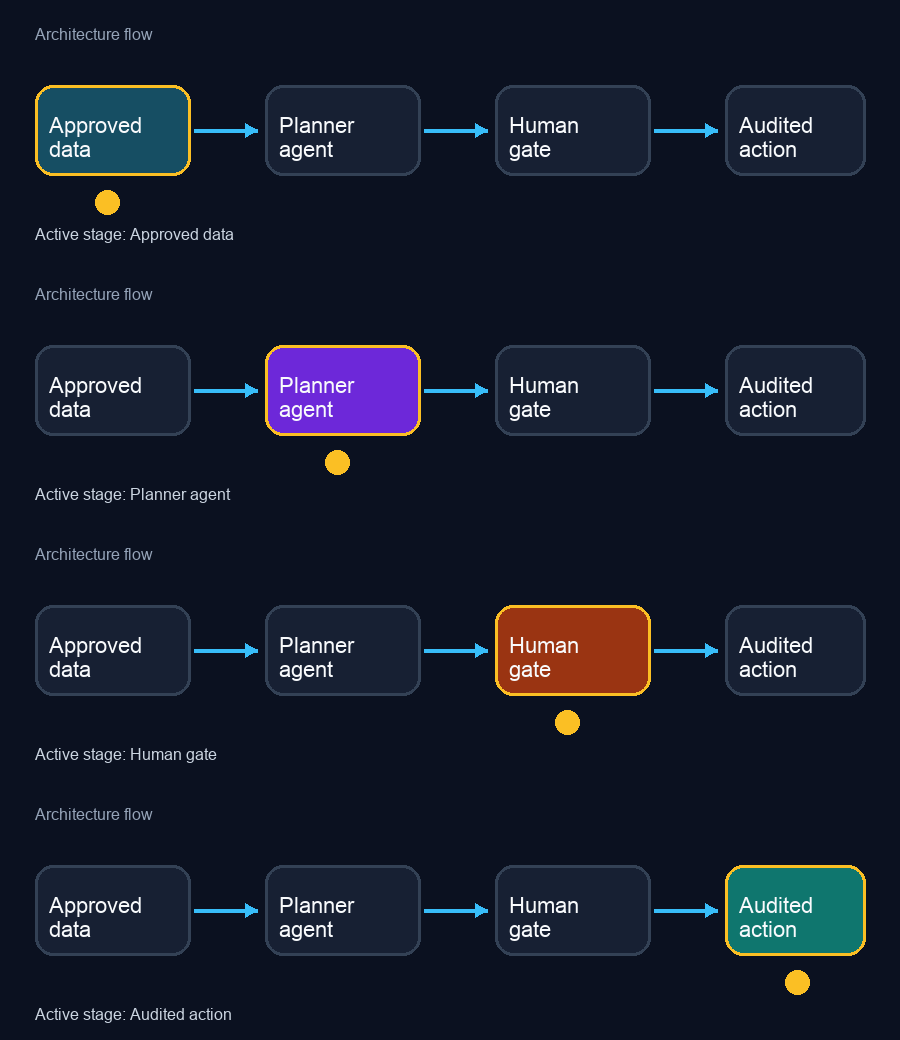
Financial workflows reward speed, but they also demand controls. The safest agent pattern is deliberately procedural: propose an action, verify it against authoritative data and policy, request the right approval, then execute through a least-privilege tool. The design makes the agent valuable without granting it unchecked discretion.
Segregation of duties matters here. A research agent can prepare an investment memo; a compliance agent can identify missing disclosures; an execution service can enforce amount and account limits. None should be able to both invent and execute a transfer. TRiSM research on agentic systems foregrounds trust, risk, and security management precisely because autonomous coordination expands the attack surface (Agarwal et al.).
Every tool call should be attributable to a task, user, policy version, and source snapshot. Retrieval should prefer approved documents; untrusted text must never be treated as a tool instruction. For money movement, include confirmation of beneficiary, amount, currency, and purpose as structured fields—not prose inferred by a model.
NIST’s Govern, Map, Measure, and Manage functions offer a practical operating rhythm: map the decision and harms, measure model and system behavior, and manage residual risk continuously (Tabassi). In my view, that rhythm is more valuable than a dramatic demo because it survives contact with real operations.
Approval is strongest when it is informed rather than ceremonial. The reviewer should see the exact proposed action, authoritative source records, policy checks that passed or failed, and the smallest set of choices needed to decide. A generic ‘confirm’ button does not establish informed accountability for an action involving money or customer access.
The audit record should be replayable. That means retaining the request, retrieved sources, tool parameters, policy version, approval event, and execution result in a durable form. The record is what enables incident review, customer support, and model improvement without depending on a model to recreate its own prior reasoning.