Apex Arena: Building Evidence-Linked Race Rooms
How Apex Arena turns live Formula racing data into a bounded, evidence-linked conversation between five specialist agents.
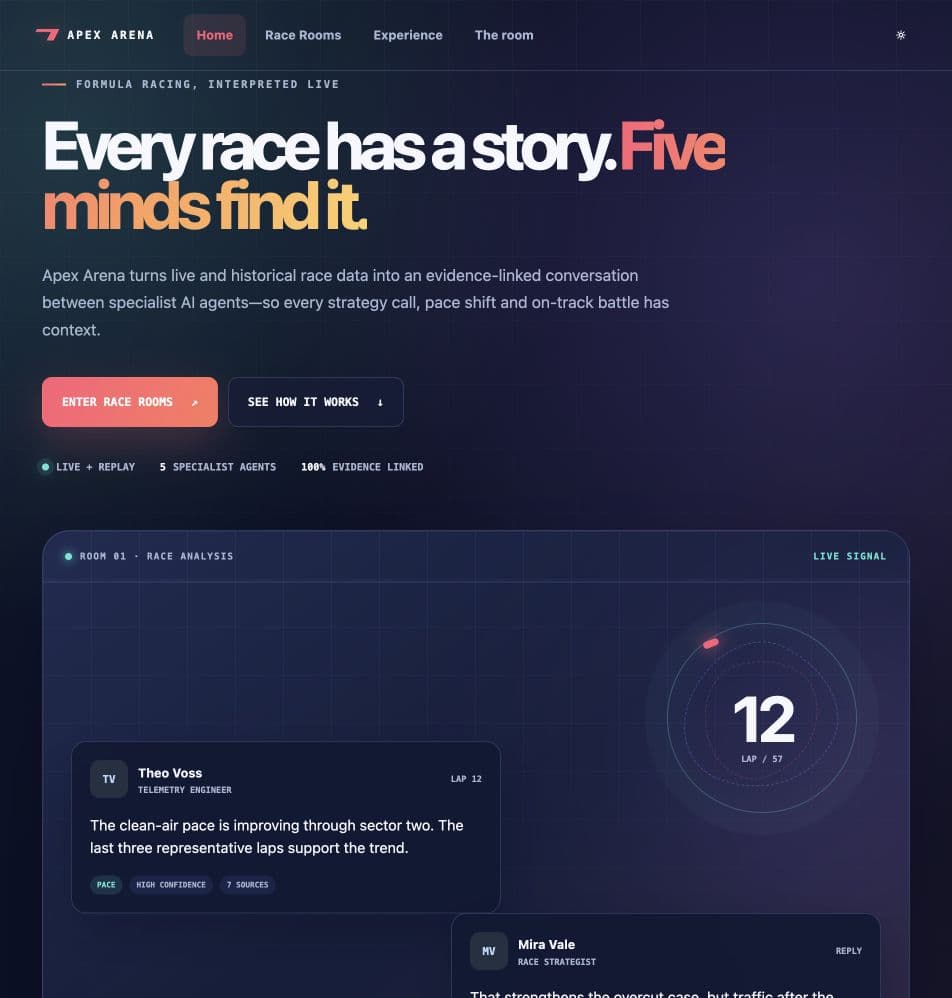
Apex Arena is not a token-optimization product. It is a Formula racing fan experience designed around an editorial premise: a race is more useful when strategy, telemetry, racecraft, and championship history can disagree in public while showing the evidence behind each grounded claim. The repository describes five specialist voices—Mira Vale, Theo Voss, Lena Cross, Arjun Reyes, and Nova—each with a narrow analytical lens and explicit confidence rules (Singh).
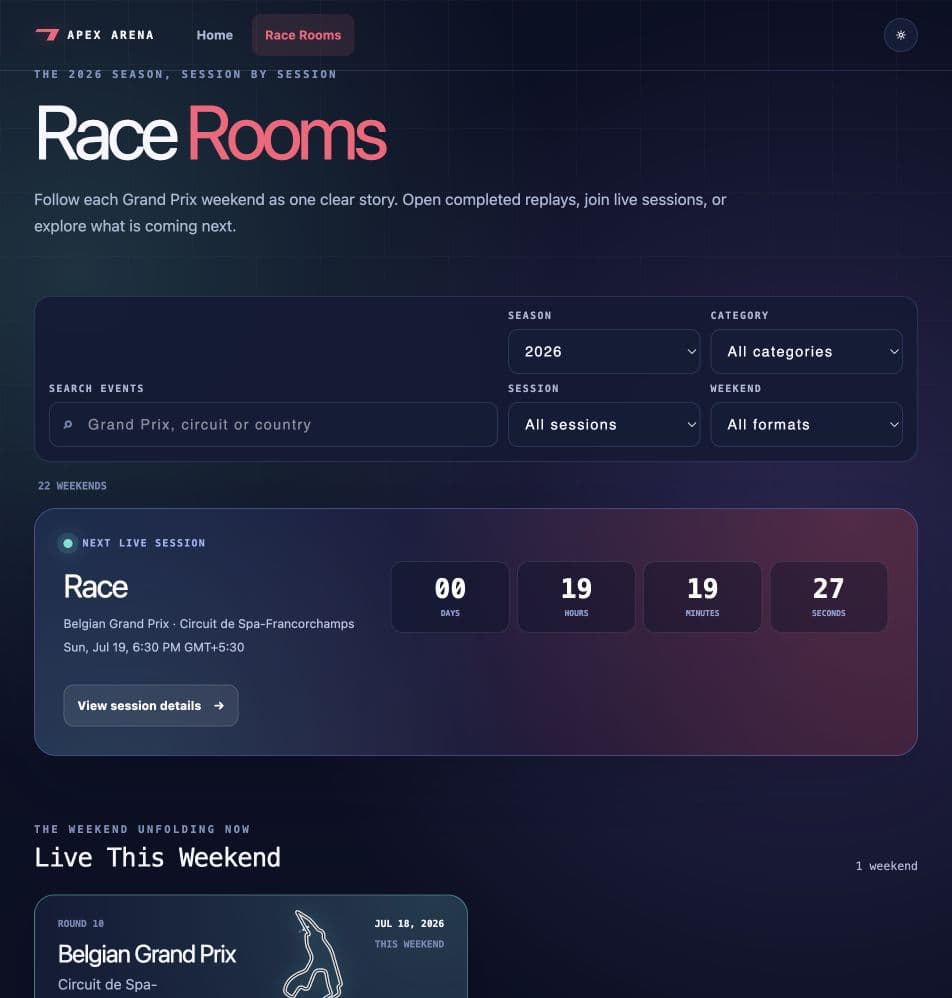
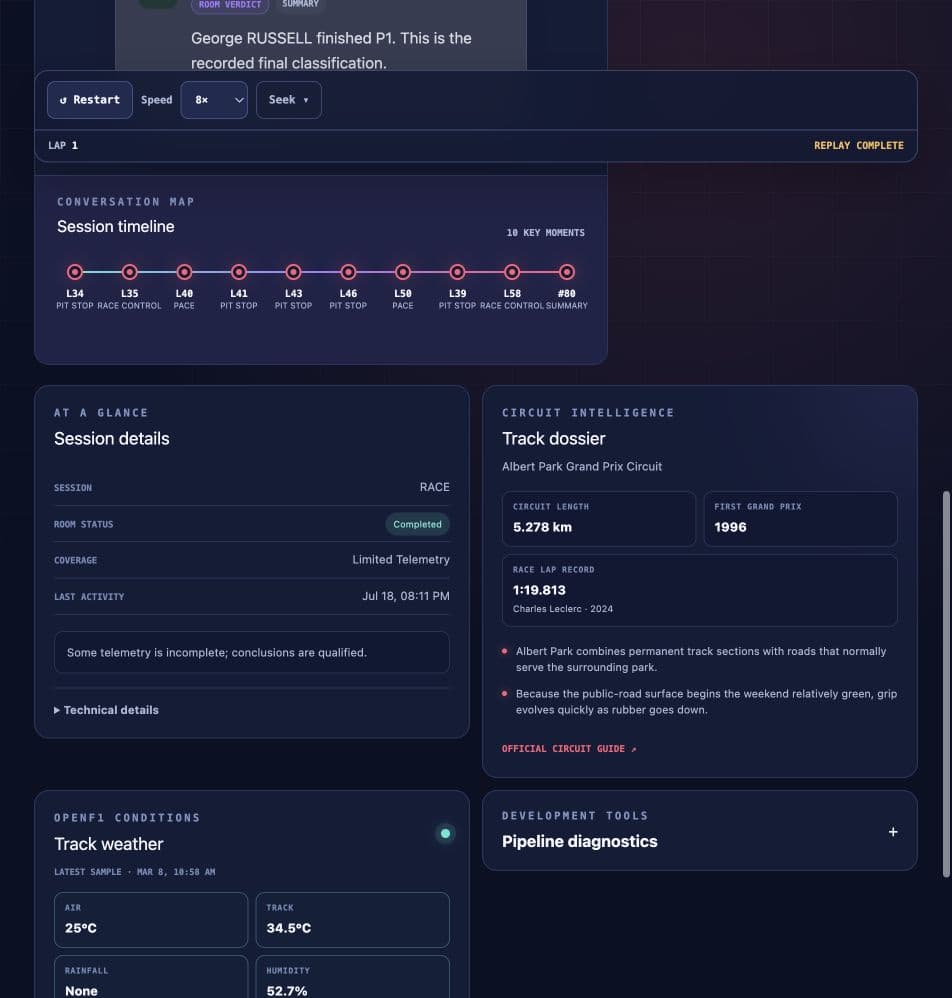
The product’s core unit is the Race Room. A room binds a session conversation, a timeline of key moments, a circuit dossier, and current conditions into one navigable surface. This makes the UX more than a timing screen: a visitor can move from a claim about tyre life or track position to the trigger, source metrics, and data-quality note that supported it.
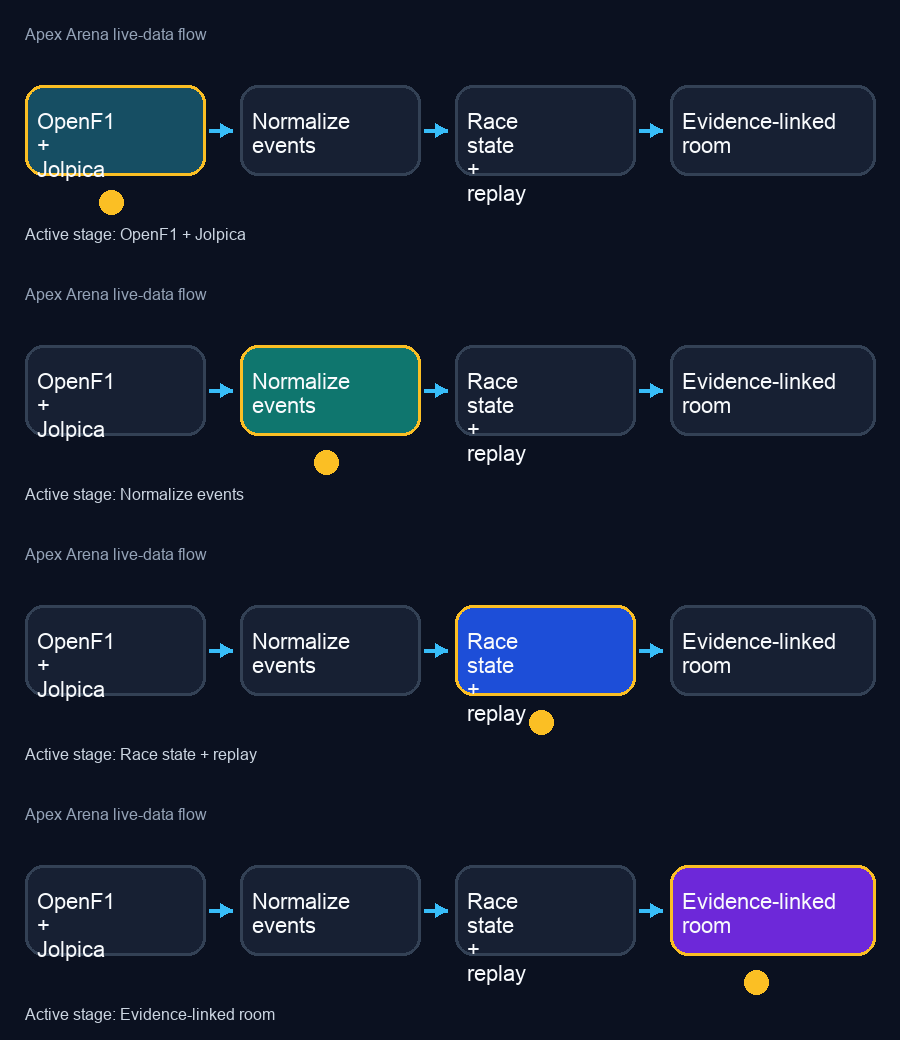
The data path is deliberately explicit. OpenF1 REST and live feeds supply timing, telemetry, race-control, and weather signals; Jolpica supplies season-calendar context. The FastAPI backend normalizes, orders, deduplicates, and stores those events in PostgreSQL while Redis carries event-stream state toward the replay and discussion engine (Singh; OpenF1).
That ordering work is not glamorous, but it is central to the credibility of a live-data product. A statement about a lap or a pit stop is only meaningful if the underlying event is stable, time-aware, and traceable. Apex Arena therefore preserves raw provider events before normalization and labels partial, missing, or unavailable data instead of completing the story with invented telemetry.
On the presentation layer, Next.js App Router, React, and TypeScript provide the Race Room experience. Server-Sent Events keep the room current without treating every interaction as a full-page refresh, while the evidence drawer, playback controls, and conversation map make the system’s reasoning inspectable rather than theatrical.
This architecture is also intentionally resilient. Weather is a panel, not a single point of failure; provider interruptions and future sessions produce clear fallback states. The same principle extends to the agents: their conclusions narrow when the available evidence narrows. The implementation is a practical example of an AI interface that makes uncertainty part of the product language rather than a footnote.