Completing Apex Arena: Shipping the Live Data and Replay Stack
Apex Arena is complete: a production Formula racing experience with resilient data handling, replayable race rooms, and a verified delivery path.
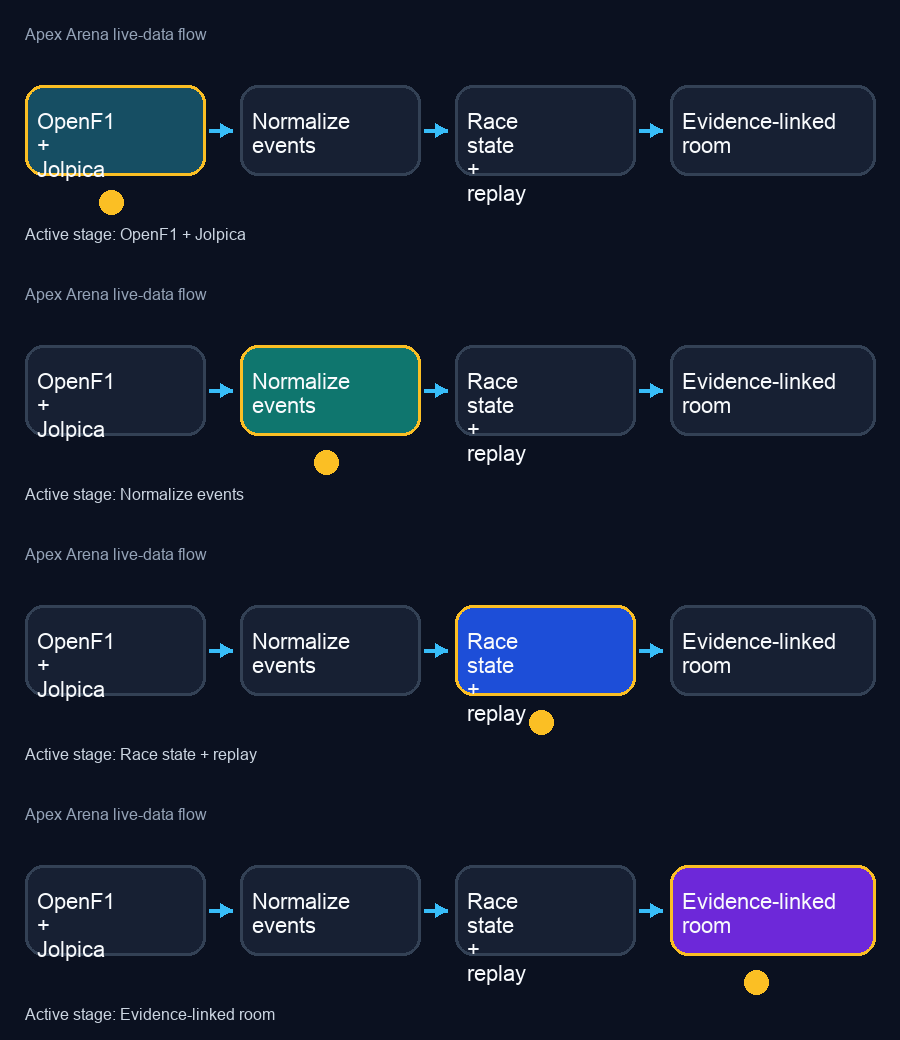
Apex Arena is complete as a production-oriented Formula racing experience, not a hybrid-token routing system. Its final form joins a Next.js frontend with a FastAPI backend, asynchronous SQLAlchemy and PostgreSQL for durable event history, Redis for event-stream state, and provider clients for OpenF1 and Jolpica data (Singh).
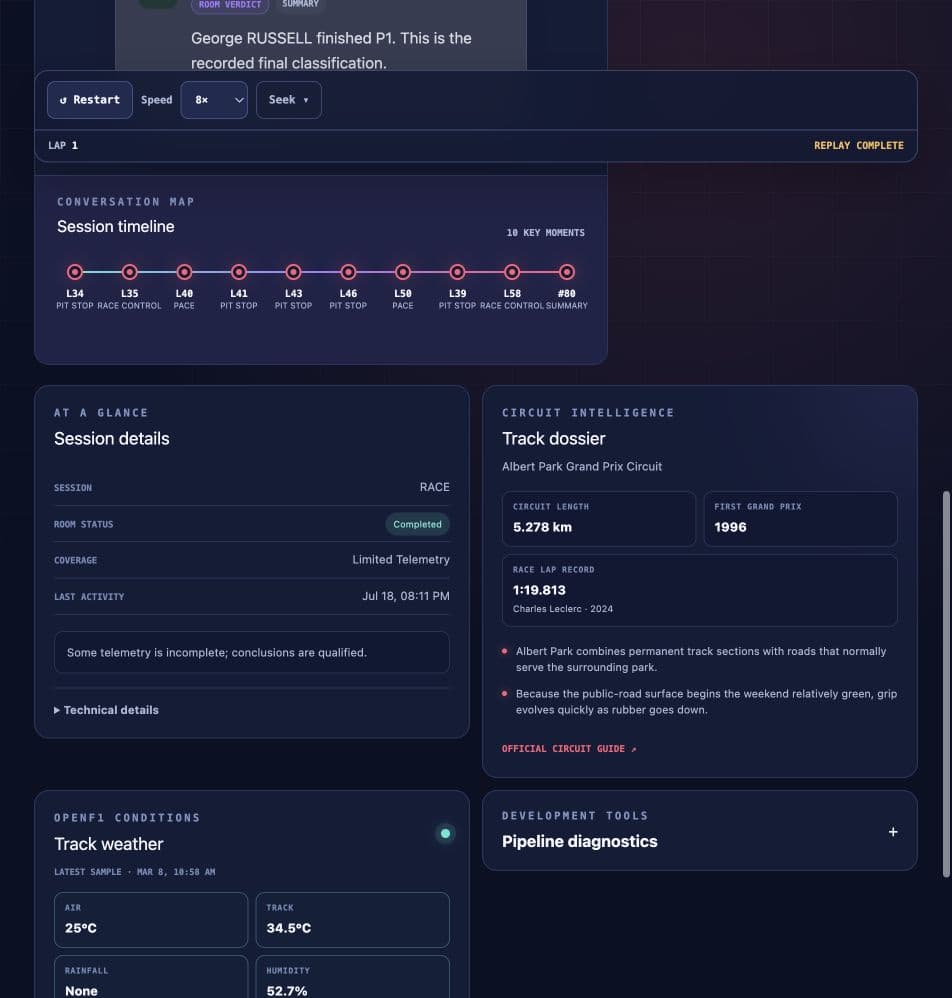
The operational centre is the race-state and replay engine. It receives normalized provider events, maintains snapshots, and presents a stable sequence for both live rooms and archived sessions. That lets a visitor replay a weekend with the same discussion model used during a current session, rather than switching between an unstructured article and a disconnected live dashboard.
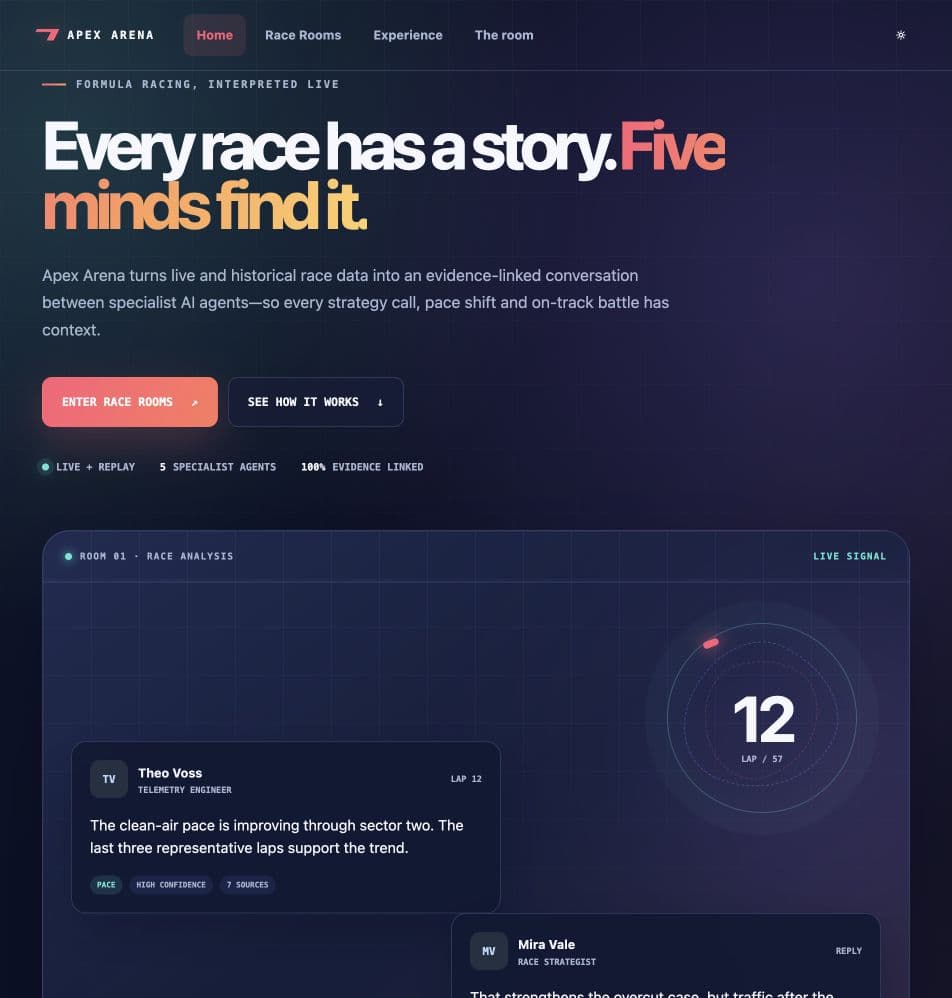
Five agents bring separate perspectives to the same evidence: strategy looks at pit windows and traffic; telemetry looks at lap and sector deltas; racecraft looks at track position and incidents; history looks at championship context; and the room host moderates confidence and evidence quality. The point is not to impersonate certainty but to make different analytical lenses inspectable.
The delivery stack reflects the same discipline. The frontend is deployed through Vercel under the portfolio’s /apex-arena path; it proxies browser-facing API calls to a Railway backend. Neon PostgreSQL and Upstash Redis provide the storage and stream layers described in the deployment documentation. Infrastructure hostnames remain off the public browser surface (Singh).
Release discipline mattered as much as the interface. The v1.0.0 pipeline requires backend and frontend checks, test suites, production builds, Docker builds, and critical-vulnerability scans before publishing versioned multi-platform container images. Reproducible releases and rollback tags make a live-data project easier to operate when a provider changes or an integration regresses.
The main lesson from completing Apex Arena is that compelling agentic UI depends on data integrity. Interfaces feel intelligent when they can distinguish a source fact from an inference, show the scope of incomplete data, and remain useful when one provider is late. That is the standard I wanted the project to meet.