Agentic AI in Medicine: Autonomy Must Stop at the Right Boundary
A safety-first view of agentic workflows for clinical support, where tools, approvals, and audit trails define usefulness.

Agentic AI is not simply a chatbot with a longer prompt. It is a system that plans, invokes tools, retains task state, and adapts its next action to observations. In medicine, that capability is attractive for tasks such as assembling a chart summary, locating evidence, or coordinating administrative steps—but it also makes the action boundary the central design question.
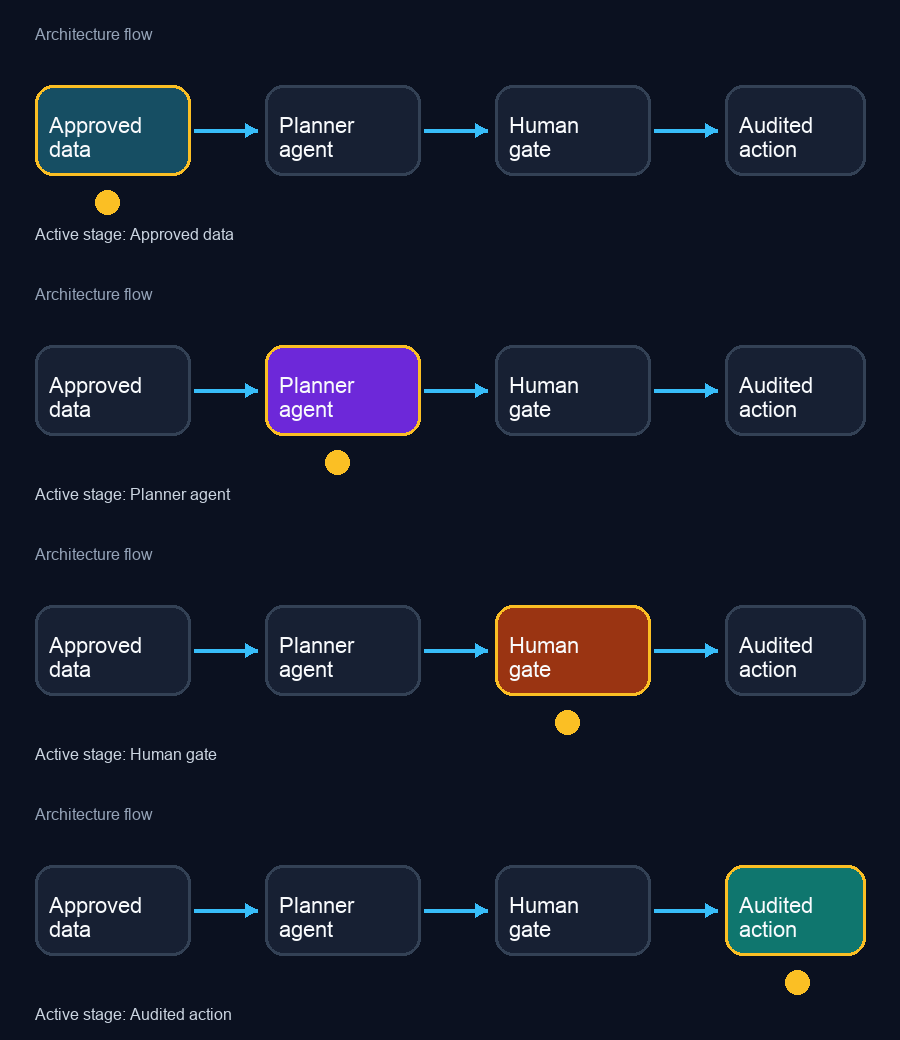
For a clinical workflow, I would give an agent narrow, typed tools and a reviewable task plan. It may retrieve a policy, draft a summary, or prepare a proposed order set; it should not silently commit a high-stakes action. Agent architecture research describes planning, memory, tool use, and multi-agent coordination as distinct capabilities, which makes those boundaries possible to test (Liu et al.).
The FDA’s AI/ML software action plan calls for lifecycle oversight, good machine-learning practices, transparency, and real-world performance monitoring. Those ideas remain useful beyond regulated device software: performance must be monitored in context, and change must be controlled rather than assumed benign (U.S. Food and Drug Administration).
A helpful rule is to make the agent’s authority smaller than its apparent intelligence. A clinician should be able to see the sources, edit the draft, reject the proposal, and understand what was not checked. That is how an assistant becomes operationally trustworthy.
Clinical usefulness also depends on workflow fit. A reliable chart-summary agent can save time only if the summary is linked to the original record, arrives at the right moment, and clearly distinguishes patient facts from generated synthesis. The safest interaction is often an editable draft that reduces clerical burden while preserving the clinician’s authority.
Evaluation must include representative clinical settings and real handoff conditions. I would measure source coverage, omission rate, citation quality, review time, and the rate at which clinicians correct a proposal. These measures are more informative than generic fluency because they reveal whether the system increases or decreases the work required for safe care.
Works Cited
- Liu, Yilun, et al. “AI Agents: Evolution, Architecture, and Real-World Applications.” arXiv, 2025.
- U.S. Food and Drug Administration. “Artificial Intelligence/Machine Learning-Based Software as a Medical Device Action Plan.” 2021.
- Tabassi, Elham. Artificial Intelligence Risk Management Framework (AI RMF 1.0). National Institute of Standards and Technology, 2023.