AI & Intelligent Systems
Hybrid Token-Efficient Routing Agent
AMD Developer Hackathon agent that solves provable tasks deterministically, accepts gated local-model answers, and escalates difficult work to larger models.
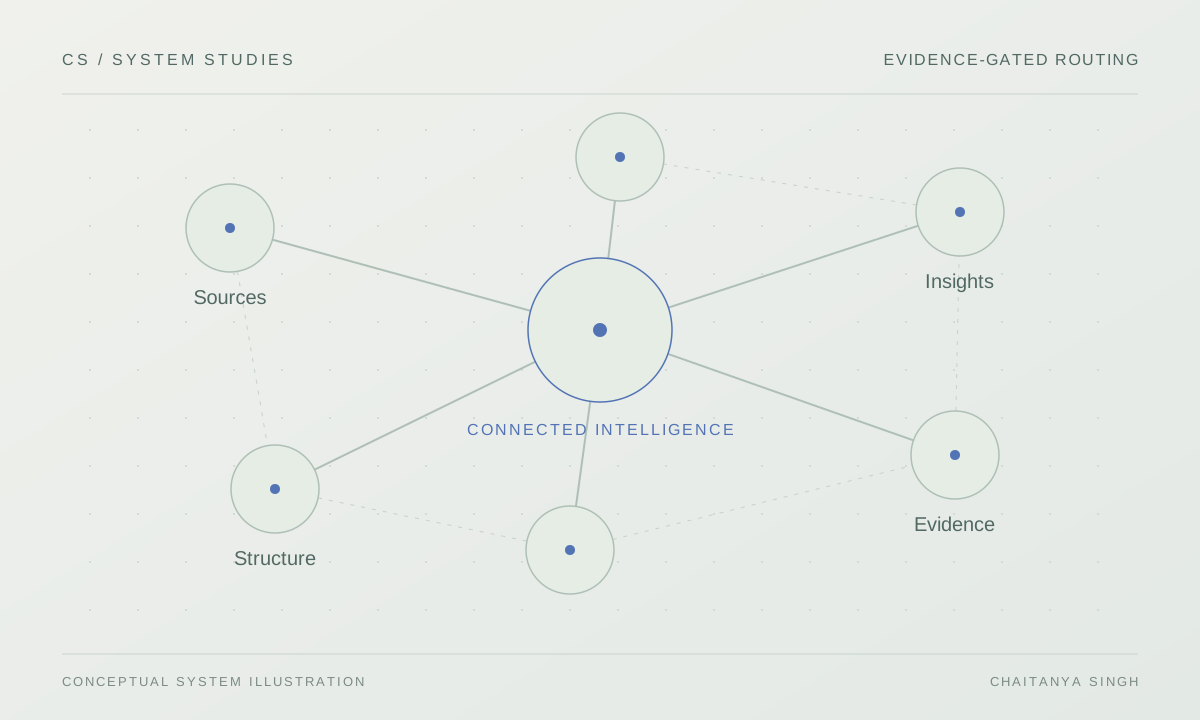
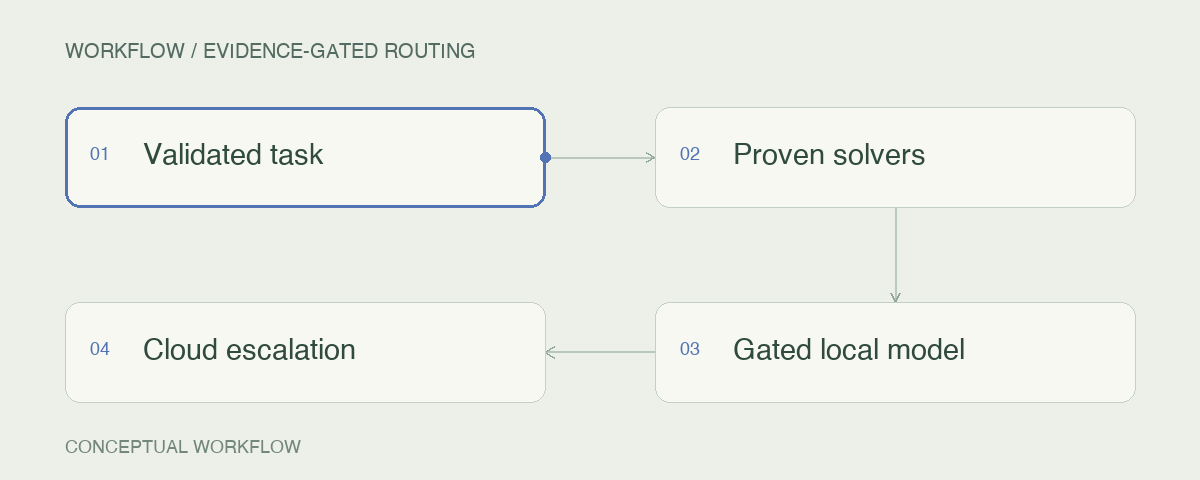
Validated task → Proven solvers → Gated local model → Cloud escalation
Overview
Built for Track 1 of the AMD Developer Hackathon ACT II, this agent routes natural-language tasks through a dependable escalation ladder. Conservative deterministic solvers answer only what they can prove, category-specific gates validate eligible local Qwen outputs, and cloud batching handles the remaining work while preserving a strict JSON output contract.
Highlights
- Uses deterministic solvers for zero-token answers when an independent proof path succeeds.
- Runs eligible tasks through a local Qwen 3.5 2B model with category-specific validation gates.
- Escalates rejected or ineligible work to configured cloud models instead of silently accepting weak answers.
- Supports eight task families: factual Q&A, math, logic, sentiment, summarization, entities, debugging, and code generation.
- Includes 282 passing regression tests and a 1,000-record synthetic evaluation dataset.
Routing Architecture
Every task passes schema validation and an ordered classifier before entering a three-tier resolution ladder. Each tier has an explicit acceptance boundary, so an unproven answer moves upward instead of being treated as correct.
- Deterministic solvers handle arithmetic, logic, extraction, and other provable patterns without model tokens.
- The local tier is category-scoped and accepts an answer only after its proof or contract gate passes.
- Cloud requests are batched and retried using runtime-configured providers and allowed models.
- A last-resort placeholder is reserved for genuine provider exhaustion or offline runs with no safe answer.
Task Coverage & Validation
- Passage-aware factual extraction and validated model fallback.
- Safe arithmetic with an independent proof path plus deterministic ordering and constraint solving.
- Constraint-aware summarization, named-entity span completeness, and conservative sentiment classification.
- AST-aware debugging repairs and contract-aware code generation that abstain on ambiguous inputs.
Local Model & Container Runtime
- The Docker image pins llama.cpp and packages the Qwen 3.5 2B local model for the grading environment.
- Environment settings control the local model, eligible categories, cloud endpoint, and allowed model list.
- The CLI reads a JSON task list and always writes one strict task_id/answer object per input task.
Evaluation & Reliability
- A 1,000-record synthetic dataset provides 125 deterministic examples for each supported task family.
- Diagnostic evaluation records the actual resolving tier without changing the submission output contract.
- Crash-safe output handling keeps results.json valid even when an upstream component fails.
- The design prioritizes accuracy before token minimization and never relies on hidden evaluation data.