Data Science & Analytics
CineJaal
Interactive cultural archive for exploring the interconnected universe of Hindi cinema across films, artists, studios, music, and franchises.
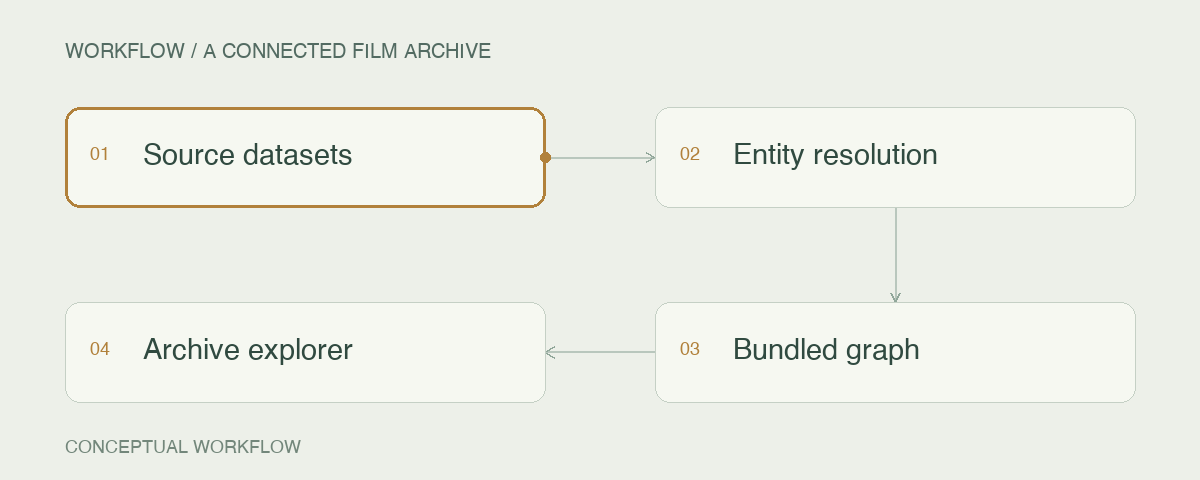
Source datasets → Entity resolution → Bundled graph → Archive explorer
Overview
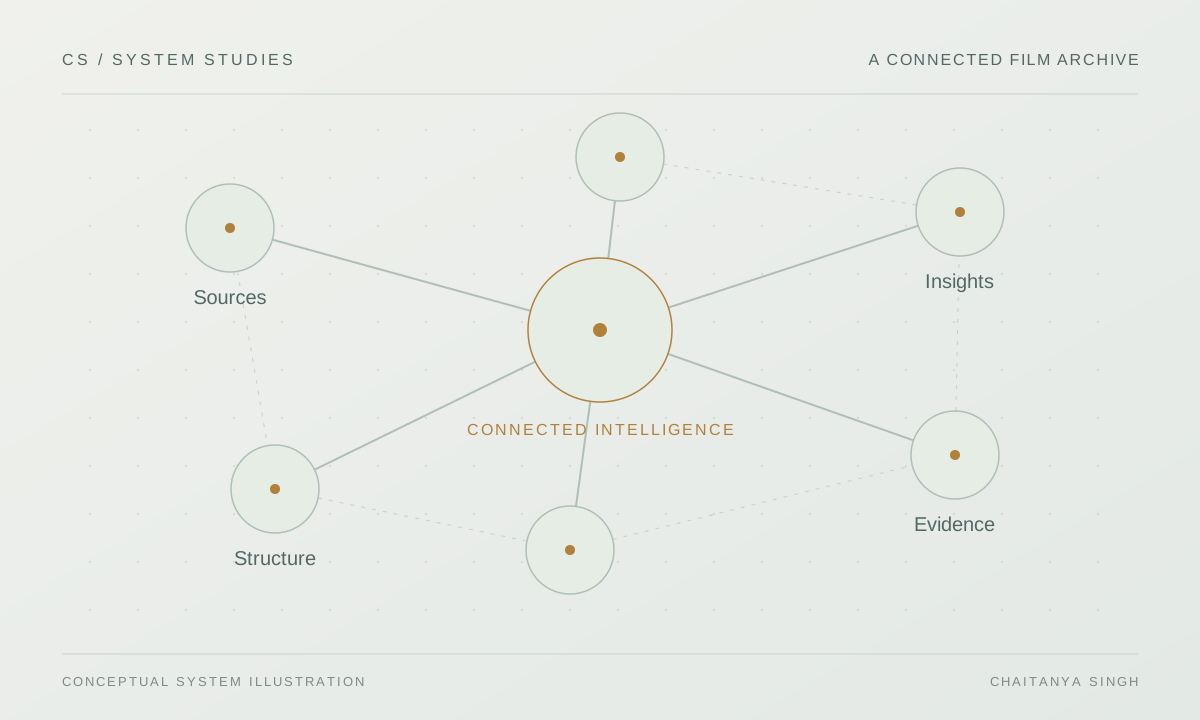
CineJaal is a browser-based Hindi cinema archive connecting films, actors, directors, music directors, singers, production houses, and franchises. Its progressive force-directed canvas stays synchronized with a 1970–2026 timeline, supports shortest-path exploration, and pairs sourced relationship data with an original deterministic poster system.
Highlights
- Archives 500 real Hindi-language films released between 1970 and 2026.
- Connects 2,096 deduplicated entities through 4,953 sourced relationships.
- Combines a progressive force-directed canvas with a synchronized historical timeline.
- Supports shortest-path exploration between people, films, studios, and franchises.
- Runs from bundled JSON at runtime, avoiding upstream availability and latency dependencies.
Archive & Graph Experience
The archive presents Hindi cinema as a connected network rather than a catalog of isolated titles. Visitors can move through a force-directed canvas while the synchronized timeline grounds each discovery in its release era.
- Covers films, performers, directors, music directors, singers, production houses, and source-backed franchises.
- Progressively reveals the graph so a large network stays navigable in the browser.
- Shortest-path exploration explains how any two entities are connected.
Data Pipeline & Provenance
- Build scripts can reuse cached sources, reproduce the committed snapshot offline, or refresh upstream inputs.
- The deployed application reads bundled JSON and makes no upstream data calls at runtime.
- Wikidata supplies CC0 structured data while IMDb fields follow its non-commercial dataset terms.
- Validation scripts check the generated archive before it is shipped.
Original Visual System
- Deterministic CSS geometry creates a consistent poster identity from factual movie metadata.
- No theatrical posters, film stills, celebrity likenesses, or third-party images are bundled.
- The visual language keeps the archive expressive while respecting source and licensing boundaries.